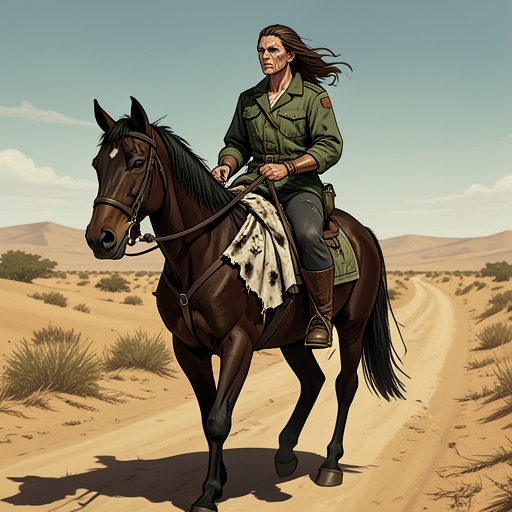
Podrick Payne
A Feast for CrowsPodrick Payne is a young squire whose uncertain movements and fierce, modest loyalty connect several strands of Brienne of Tarth’s story. First encountered as a scrawny boy in chainmail, carrying a longsword far too conspicuously for his age, he appears vulnerable and suspicious at once. His decisive importance lies in the purpose that survives his abandonment: although Tyrion Lannister has left him behind, Podrick continues trying to find Tyrion’s wife, Sansa Stark, and becomes Brienne’s companion in the search.
Identity and Introduction
Podrick is no more than ten or twelve when Brienne meets him in Duskendale. He has straight, thin hair, a sty beneath one eye, a chainmail byrnie, and a longsword in a leather sheath slung across his back. Their collision knocks him into the mud; when Brienne offers him a hand, he scrambles away on his heels and elbows instead of accepting it. His frightened evasiveness makes his appearance memorable before his identity is known.
The boy’s speech reinforces that impression. He stammers apologies, insists that he was looking down at his feet, and then runs away. Brienne recognizes him from outside the gates that morning, where he had been riding a piebald rounsey, and suspects that she has seen him elsewhere as well. His recognition is therefore delayed by fear and concealment: he is not introduced through a formal announcement, but through a collision, an attempted escape, and fragments of a face Brienne cannot immediately place.
Abandonment and Purpose
Podrick is identified as Tyrion Lannister’s squire. Brienne is surprised that Tyrion, who is no knight, had a squire rather than merely a serving boy, page, or cupbearer. The title nevertheless gives the boy a clear place within Tyrion’s household and explains why he possesses arms and armor despite his youth.
When Brienne asks why he has been following her and what he wants, Podrick answers that he is trying to find Tyrion’s wife. Brella told him that Brienne was looking for her, and he has connected that search with Sansa Stark. His account carries both practical information and emotional pain: he repeats that he is Tyrion’s squire, then says that Tyrion left him. The abandoned servant is not seeking revenge or reward; he is trying to recover the person and purpose that his former master’s departure took from him.
Podrick’s loyalty is consequently active rather than ceremonial. Even after being left behind, he continues to identify himself through the relationship, and his search for Sansa becomes a means of remaining faithful to Tyrion. The boy’s purpose also intersects with Brienne’s own vow-bound mission, making his private abandonment part of a larger pursuit across a fractured realm.
Companion to Brienne
Podrick travels with Brienne while she searches through country marked by earlier violence. On the road, he asks what she is looking for when she studies an old wall and tries to identify the site where Cleos Frey was killed and where Brienne and Jaime Lannister once fought. Brienne answers that she is looking for a wall she rode past before, while warning him to remain quiet because outlaws may still be in the woods.
His response shows how he understands his role beside her. He points to the longsword he carries and says that he can fight. The assertion is brave but also revealing: Podrick’s usefulness is something he must claim despite his age, uncertain status, and Brienne’s instinct to protect him. His weapon is both equipment and argument, a visible sign that he wishes to be treated as a participant rather than as helpless baggage.
Brienne does not regard him simply as a burden. Her questions, suspicion, warnings, and continued attention place him within her practical concerns, while his willingness to follow her keeps the search from being an isolated mission. Their partnership is unequal in experience and authority, but it is reciprocal in purpose: Brienne offers protection and direction, while Podrick supplies loyalty and a reason to keep moving toward Sansa.
Courage Under Threat
Podrick’s claim that he can fight is tested when seven riders arrive through the rain, some wounded and all carrying the signs of armed men. Their leader is enormous, pale, hairless, and covered in weeping sores; beneath his hood Brienne glimpses an iron snout and rows of steel teeth. The riders are plainly not friends, and Brienne reacts by drawing Oathkeeper.
She tells Gendry that he needs a sword and armor and warns him that the riders are no one’s friends. Podrick is not named in that immediate exchange, but the scene establishes the danger surrounding Brienne’s traveling party and the martial world into which the young squire has inserted himself. His earlier insistence that he can fight is set against a threat that exceeds the ordinary test of youthful bravery. The contrast sharpens his position: Podrick carries the symbols of a warrior, yet remains a child confronting experienced and possibly mutilated enemies.
His significance in these encounters is therefore not that he has already become a formidable fighter. The evidence instead presents a boy who keeps moving toward danger because loyalty has given him no safer identity. His armor, sword, nervousness, and persistence form a single image of premature responsibility.
Narrative Role
Podrick serves as a hinge between absent and present characters. Tyrion’s abandonment is felt through him; Sansa’s disappearance gives him a destination; and Brienne’s search provides him with a path. He brings information about Tyrion and Sansa into Brienne’s immediate world, but he also embodies the human consequences of political upheaval: a household servant separated from his master must navigate roads, suspicions, and armed threats without adult security.
His introduction through suspicion gradually becomes an introduction through loyalty. Brienne first sees a boy who flees from a helping hand and refuses to explain himself. She then discovers a squire trying to fulfill an abandoned duty, a traveling companion willing to speak up about his sword, and a vulnerable figure caught in the path of violence. Podrick’s arc within the supplied material is small but sharply defined: concealment gives way to recognition, abandonment becomes purpose, and fear is repeatedly accompanied by the decision to remain useful.